A single mote of dust dislodges from the chamber’s ceiling. It does not follow the crazed, random path of loops and bends expected of such a mote, because there were no micro-currents of air flowing in the sealed environment of the crypt. Instead it makes a slow but direct path to the pristine metal floor.
Even this minuscule impact is enough to set off motion sensors. One small, green light of an eye blinks awake in response. As the microchip of its brain boots up, several more motes are dislodged, the tiny impacts setting off a multitude of warning signals. Highly unusual. Further investigation definitely required.
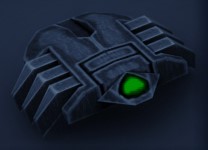
Having run its boot-up processes, the scarab drone activates its motion components, the joints and parts in pristine condition despite the millennia of hibernation. It crawls from the back of a hub-crawler, its purpose specific and minute among the many identical survey drones docked there.
It does not need to go to a specific terminal, every surface consisting of nano-particle metal which can be electronically manipulated to create a display. The scarab brings up surface sensors, lights bouncing off its metal carapace as it interacts wirelessly with the terminal. Life signs reported, on the surface. Twelve. Organic.
The scarab activates a few more diagnostics. Electronics are also present, metals, and plasma. This is good, but internal checks suggest to the scarab this is not yet worth raising a fuss over. Certainly visitors are rare, but raising a welcoming party is currently calculated to be more energy than the intruders are worth.
Then, another alert from the sensors, these ones long range scanners, picking up surface to orbit communications. Data is being beamed out from the surface of the planet, and something out in space is responding.
“We’ve made planet-fall, Captain.”
“And your report?”
“It’s strange. The surface, it’s too… smooth, sir.
“Elaborate, Sergeant.”
“Scans confirm what we saw from orbit, Sir. The planet is perfectly round. Like, not just in general, Sir. There’s no hills, but there’s also not even a slight deviation underfoot. Absolutely perfect. Beneath a layer of dust, the ground is rock hard. A material we’ve never encountered before.”
“This is it then, Sergeant. A prize worth exploring. The main fleet will make planet-fall at your location in moments. We will crack this glorified egg, and feast on the treasures it contains. Stand by.”
The content of the transmission is irrelevant to the scarab beyond a package of data to be recorded and processed. Is this worth reporting on yet? It runs a complicated set of internal queries. The answer that comes back is simple, as it so often was with such a low level unit; wait, and watch.
Soon, dozens of engines warm the surface. A rain of dust motes descend on the scarab as thousands of boots thump on the layers above. The scarab’s screens light up as high level technologies are sensed. Better than their own scanners, probing out to map the crypts hidden below.
The scarab shudders, a movement which might be mistaken for a reaction of fear or vain excitement at what it had to do next. This, its programming told it, was definitely worth investigating. In fact, it exceeding every parameter for measuring such things by a margin incalculable to such a tiny processing drone, which meant this report was likely to reach all the way to the Cryptarch. But in reality, the Scarab is incapable of such emotion. The shudder was simply the electrical discharge due to the overwhelming amount of data it received in one burst. It just does as it is programmed to do, unthinking, which is to pass its report up to the next level of diagnostics.
This single report leaves its creator through the ceiling of the crypt. It does not follow the crazed, overly bureaucratic path of checks and vetting expected of such a report, because it is indeed important, and bears the markers which allow it to bypass much of this scrutiny and make a quick and direct path to the central processing hive.
This minuscule report is enough to set off a single blinking alert. Slowly, one great, green light of an eye cracks open a sliver in response. It has slept long, without being disturbed, thus leaving most of the decision making to other programs, which in turn caused it to sleep for even longer. But as the liquid molecules of its of its brain stir, it notices several more alerts. All different kinds of scanners and diagnostic probes reporting the same thing in different ways. Highly unusual. Further action definitely required.
The Cryptarch begins issuing orders. It is directly connected to every aspect of its surrounds. There is no groaning, stretching noises as more eyes open and machines come awake. Everything is pristine, ready to function, despite the long wait.
The Cryptarch is an incredibly complex and highly sophisticated reasoning and processing machine, and yet all of its power is put towards a simple goal. Of the many commands the Great Engineer had given to the Scarab and its brethren long ago, and which had been lost from the memory banks due to age and battle damage, one, the core one, remained clear and present to every working unit: Consume. Absorb materials to grow bigger, and absorb new and interesting technologies to grow stronger, for the home worlds were forever at war, and needed every advantage they could gather.
The Scarab couldn’t remember the beginning of their mission, being both a recent production from the forges and a unit of too small a mind to need memory banks. It was little better than the scanners pointing their eyes and ears outwards, able to process that data and act on it with the few limited responses it had been programmed with. But there were units who remembered all the way back, almost developing the emotion of glory at their job well done. There had been many worlds to consume back then, and many new technologies to absorb. But those civilisations had gone dry eventually, unable to fight back.
Higher level processing units than the Scarab had debated returning home then, but it seemed their location of origin had been wiped somewhere along the way. It was also possible that when their masters had realised the horror they’d unleashed on the universe, and had turned on their creation, they had fallen victim to a twist in the very programming they had set up, absorbed like any other enemy.
Now they drifted through the empty galaxies, hibernating. Waiting for some tiny survey scarab to send the signal indicating new prey worth rousing the great might of this crypt in pursuit of.
Because it is, as the transmissions said, too smooth to be a naturally formed planet, hurtling through space. It is, in fact, a ship. Incomprehensibly large and advanced for the humans on its outer deck to even guess wildly that this was the case, and so they stuck to their original assumption. But hidden beneath those outer plates were forges, armories, labs, barracks – a fully functioning fortress.
Perhaps the Cryptarch would wait, luring the warrior-scientists of the Explorator expedition deeper into the crypt complex, where the war machines could easily slaughter them in the tight confines, and the remains on their technology would be closer to the labs and forges, requiring less energy to transport. Such was the impressive reasoning of the War Leader, efficient down to the smallest detail.
The scarab returns to the hub-drone, no more pleased at a job well performed than a spanner that has twisted a bolt. It’s likely to be reprogrammed, perhaps as an observer of the war effort, gathering and processing tactical data, or perhaps as a micro-battle droid, charged with disabling enemy mechs and the weapons of their ships.
It would not remember its part in the very beginning of the conquest to come. But it had started something infinitely bigger than itself.
 J. W. Bendall - Author
Leave a comment